What a Fixed-Price Web Proposal Should Contain
What a fixed-price website proposal should contain: scope, price, timeline, exclusions, ownership and support, plus the warning signs to check first.
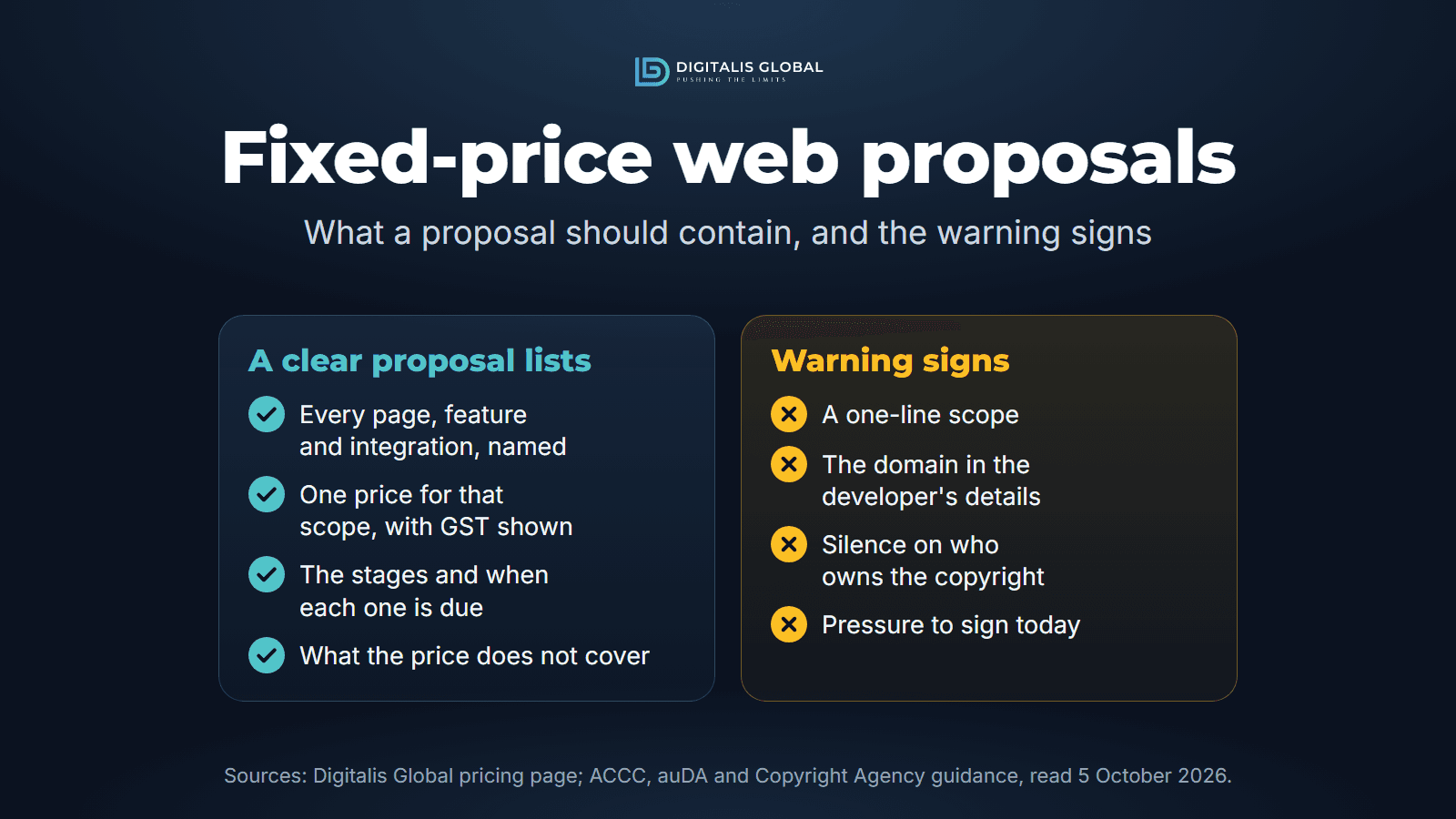
A fixed-price web proposal should describe the work closely enough that you could check the finished website against it line by line, and tell you the full cost before anything starts. That takes ten things in writing: the scope, item by item; one price for that scope; a timeline with stages; the exclusions; what you need to supply; how changes are handled; how payment is staged; who owns the code, design files, domain and accounts; what happens after launch; and the agreement you are signing. The general points below are our advice as a web development agency, not legal advice. Where we describe how Digitalis Global quotes, it is what our pricing page and service pages already say.
The ten parts at a glance
Use this as a checklist when a proposal arrives.
| Part | What a clear proposal says | Warning sign |
|---|---|---|
| Scope | Every page template, feature and integration, named. | One line, such as "five-page website with CMS". |
| Price | One price for the listed scope, with GST shown. | A range, a "from" figure, or an hourly rate presented as a quote. |
| Timeline | The stages of the work and when each one is due. | A launch date with no stages behind it. |
| Exclusions | What the price does not cover, written down. | None listed, so they arrive later as extra invoices. |
| Your inputs | What you supply (content, images, logins, feedback) and by when. | Nothing about who writes the copy. |
| Changes | How extra work is priced and approved before it starts. | Extra work billed after the fact. |
| Payment | What each payment is for and when it falls due. | Payments with no link to a stage you can check. |
| Ownership | When the code and design files pass to you; the domain and accounts in your business's name. | Silence on copyright, or a domain in the developer's details. |
| After launch | What is fixed at no cost, for how long, and what counts as a bug. | "Ongoing support" with no definition. |
| Agreement | The service agreement or terms, sent with the proposal. | Terms you only see after you have paid. |
Fixed price, estimate or hourly rate
First check what kind of price you have been given. The three common forms behave very differently once the work starts.
| Question | Fixed price | Estimate | Hourly or day rate |
|---|---|---|---|
| What you are told | One price for a listed scope | A forecast of the likely cost | A rate, sometimes with a forecast of hours |
| If the work takes longer | The supplier carries it, for the agreed scope | The bill can rise | The bill rises |
| Best suited to | A defined build, such as a website or online store | Early budgeting, before the scope is known | Open-ended or exploratory work |
A fixed price protects you only as far as the scope is written down. Anything the proposal does not list sits outside the price.
Scope: the part that decides the price
Most disagreements start with the scope, because "a website" can mean five pages of text or a booking system connected to a CRM. On our pricing page, what moves the price of a website is the number of page templates and custom features, integrations with systems such as a CRM, booking tool or payment provider, whether you need a CMS to edit content yourself, who writes the copy and supplies the images, and moving content from an existing site. For an online store, add products and variants to import, payment, shipping and tax rules, apps, and migration from another platform. A good scope answers each of those in writing:
- The page templates, and which pages use each one.
- Every feature in plain words: forms, search, filters, bookings, logins, payments.
- Every integration by product name, and what data moves between the systems.
- Content: who writes it, who loads it, and how much moves from the old site.
- Launch work: analytics, conversion tracking, redirects from old addresses and an XML sitemap.
- Accessibility, as a named standard and level.
On that last point, the Australian Human Rights Commission's April 2025 guidelines describe the Web Content Accessibility Guidelines (WCAG) as the applicable international standard for web accessibility, and say it is important to meet the latest published version. The guidelines are not legally binding and are read with the Disability Discrimination Act (Australian Human Rights Commission, Guidelines on equal access to digital goods and services, read 5 October 2026). If your site must meet a level, ask for the WCAG version and level in the scope, not a promise of "accessible design".
Price, payment stages and third-party costs
The price should be one figure for the listed scope, with GST shown as included or added. Ask what each payment is for and what you will have seen by the time it falls due. Payments tied to stages you can check, such as approved designs, a working preview or launch, keep both sides honest about progress.
Third-party costs belong on their own lines: hosting, the domain, paid themes, plugins or apps, fonts and stock images, email, and for advertising, the ad spend itself. Ask who pays each one, whose name the account is in and whether it renews. Our guides to what a website costs in Australia and what a Shopify store costs list those running costs with their sources.
Read the price and the scope most carefully of all. The ACCC notes that Australia's unfair contract terms law does not apply to terms that set out the upfront price or define the main subject matter of the contract (ACCC, Contracts, read 5 October 2026).
Timeline, and what you need to supply
A useful timeline breaks the work into stages, such as design, build, testing and launch, with a date for each, and says what it depends on from you: content, brand files, logins and feedback. Ask what happens to the dates if your content is late, and how many rounds of design changes are included. Our web development page says the proposal gives a fixed timeline once the scope is agreed, and states what we need from you, and when, to keep to it.
Exclusions and assumptions
Exclusions are what the price does not cover, "written down so nothing comes as a surprise", in the words of our pricing page. Common ones are copywriting, photography, stock image licences, paid plugins and apps, hosting and domain fees, translation, ongoing SEO, and ad spend. None is unusual to exclude; what matters is knowing before you accept.
Assumptions are the facts the price relies on, often that a system you already use can be connected. Our web development page says we confirm each connection during discovery, because a system without a usable API changes the scope. Ask for the assumptions to be listed, so you can see what would change the price.
Changes after you accept
New ideas arrive during every build, so the proposal should say how they are handled: you describe the change, the supplier prices it and says how it moves the timeline, you approve it in writing, and only then does work start. Our pricing page says that if you later ask for something the proposal does not list, we quote it separately and start it only once you agree, and the price for the agreed scope does not change.
Check the agreement for the opposite. Since 9 November 2023, proposing, using or relying on unfair terms in standard form contracts has been banned, with penalties. For a new or varied standard form contract, a small business is covered if it has fewer than 100 employees or makes less than $10 million in annual turnover. The ACCC's examples of terms that may be unfair include terms that let one party, but not the other, change the contract, end it, limit their responsibilities, or penalise the other for breaching or ending it. Only a court can decide a term is unfair (ACCC, Contracts, read 5 October 2026).
Ownership: code, design files, domain and accounts
Paying for a website does not, by itself, make you the owner of its copyright. As a general rule, the first owner of copyright in a work is its creator, unless the creator has assigned copyright in advance. Where there is no agreement, the exceptions are an employer, for an employee's work; a client who commissions a portrait, private photograph, video or audio recording; and the Commonwealth or a State, for government material (Copyright Agency, Ownership, read 5 October 2026). A commissioned website is not on that list.
So the agreement should say when the code, design files and creative assets pass to you. Ours transfers them to you on project completion and final payment, under an NDA and service agreement signed before work begins. Themes, plugins, fonts and stock images are usually licensed rather than owned, so ask whose name each licence is in.
The domain should be in your name from day one. auDA, which administers .au domains, says a web developer can register a com.au domain for you with your explicit written permission, but should use your details, such as your name, contact details and ABN, because those details show who holds the domain name licence (auDA, com.au domain names, read 5 October 2026).
The same goes for hosting, analytics, your store platform and ad accounts, and none of them needs a shared password. Google Ads lets you invite a user by email and remove access later (Google Ads Help, Manage access, read 5 October 2026), and in Meta Business Suite only the organisation that owns an asset, such as an ad account, can share it with another business (Meta Business Help Centre, Give a partner access to business assets, read 5 October 2026).
After launch: fixes, support and care
The proposal should define how long problems in the delivered work are fixed at no cost, what counts as a bug rather than a change, how quickly the supplier replies, what is handed over, and what ongoing care costs. "Support included" means little until those are written down.
Our web development page is specific: for 30 days from launch we fix bugs in the work we delivered at no extra cost, meaning anything in the agreed scope that does not work as agreed. New features and content changes are not bugs, and we quote them separately. We reply within 24 hours, which is a reply time, not a promise that every fix is finished within a day.
Who does the work
Ask who will build your site, where they work and who your contact is. Digitalis Global has team members in Sydney and Newcastle NSW. Our development headquarters is in Rawalpindi, Pakistan, and scoping and calls run in Australian business hours. We work remotely and have no walk-in office.
Five checks before you sign
-

Check 1
Hold the scope against your brief
- Every page and feature named
- Missing means not included
Tick off every page, feature and integration from your brief. Anything not listed sits outside the price, so raise it now.
-

Check 2
Find the exclusions and assumptions
- Content, licences, hosting, ad spend
Ask what would happen to the price if an assumption turned out to be wrong.
-

Check 3
Confirm what you will own
- Domain in your details
- Accounts in your business's name
- Copyright transfer in writing
The supplier should be invited into your accounts, not the other way round.
-

Check 4
Read the agreement, not only the proposal
- One-sided change or exit terms
Ask for the terms with the proposal, and take advice on anything you do not understand.
-

Check 5
Know what happens after launch
- Fix period
- What counts as a bug
- Reply time
Get the fix period, the definition of a bug and the cost of ongoing care in writing.
More warning signs
Ask about these before you accept
- A price that can move "if the project grows", with no change process.
- "Unlimited revisions" with no definition of a revision or of when design is signed off.
- Guaranteed rankings or sales: no developer controls Google's results or your market.
- Pressure to sign today: the ACCC says it is illegal for businesses to force or pressure consumers or other businesses into entering a contract.
How we write our proposals
For comparison, this is what our own pages commit to. We reply to an enquiry within 24 hours, scope the work on a free call, then send a written proposal with the scope, a fixed price, the timeline and the exclusions. Nothing starts until you accept it, and before work begins we sign an NDA and a service agreement with you. Web and app projects include a 30-day post-launch bug-fix guarantee at no extra cost.
We publish no price list, because two websites with the same name rarely have the same scope, so every project is quoted after scoping. Read how we scope and quote, or see what our web development and e-commerce development services include.
Common questions about website proposals
What should a website proposal include?
The scope item by item, one price for it, a staged timeline, the exclusions, your inputs, how changes are approved, the payment stages, who owns the code, domain and accounts, what happens after launch, and the agreement it sits under.
Is a fixed price better than an hourly rate for a website?
For a defined build it usually is, because the supplier carries the risk of the work taking longer, for the agreed scope; an hourly rate suits open-ended work whose scope cannot be pinned down yet.
Who should own the domain name?
Your business: auDA says a developer can register a com.au domain for you with your written permission, but should use your name, contact details and ABN (auDA, read 5 October 2026).
Who owns the website code after it is built?
Whoever the agreement says, so get it in writing: as a general rule copyright starts with its creator unless assigned, and a commissioned website is not one of the listed exceptions (Copyright Agency, read 5 October 2026).
Can the price change after I accept a fixed-price proposal?
It should not for the agreed scope; extra work should be priced and approved in writing first, and a term letting only one side change the contract may be unfair (ACCC, read 5 October 2026).
Do I need a lawyer to read a web development agreement?
Not always, but the ACCC's advice is to talk to a lawyer if you do not understand a contract's terms and conditions, and a large build is worth that check (ACCC, Contracts, read 5 October 2026).
Sources
Every source below was read on 5 October 2026. Guidance and rules change, so check the linked page before you rely on it. Nothing in this guide is legal advice.
- ACCC: Contracts (unfair contract terms, the 9 November 2023 changes, small business thresholds, examples, pressure to sign)
- Copyright Agency: Ownership (first owner of copyright and the exceptions)
- auDA: com.au domain names (registering a domain on someone else's behalf)
- Australian Human Rights Commission: Guidelines on equal access to digital goods and services (April 2025)
- Google Ads Help: Manage access to your Google Ads account
- Meta Business Help Centre: Give a partner access to business assets in your business portfolio
- Digitalis Global: Pricing: how we scope and quote and Web development (our own process, as published)
Drafted with AI assistance; researched and reviewed by Saad Ali.
Founder / CEO