Ads in ChatGPT: What Users and Advertisers Are Actually Reporting (2026)
ChatGPT has shown ads in Australia since April 2026. OpenAI's rules, what users and advertisers report, and what an Australian business should do now.
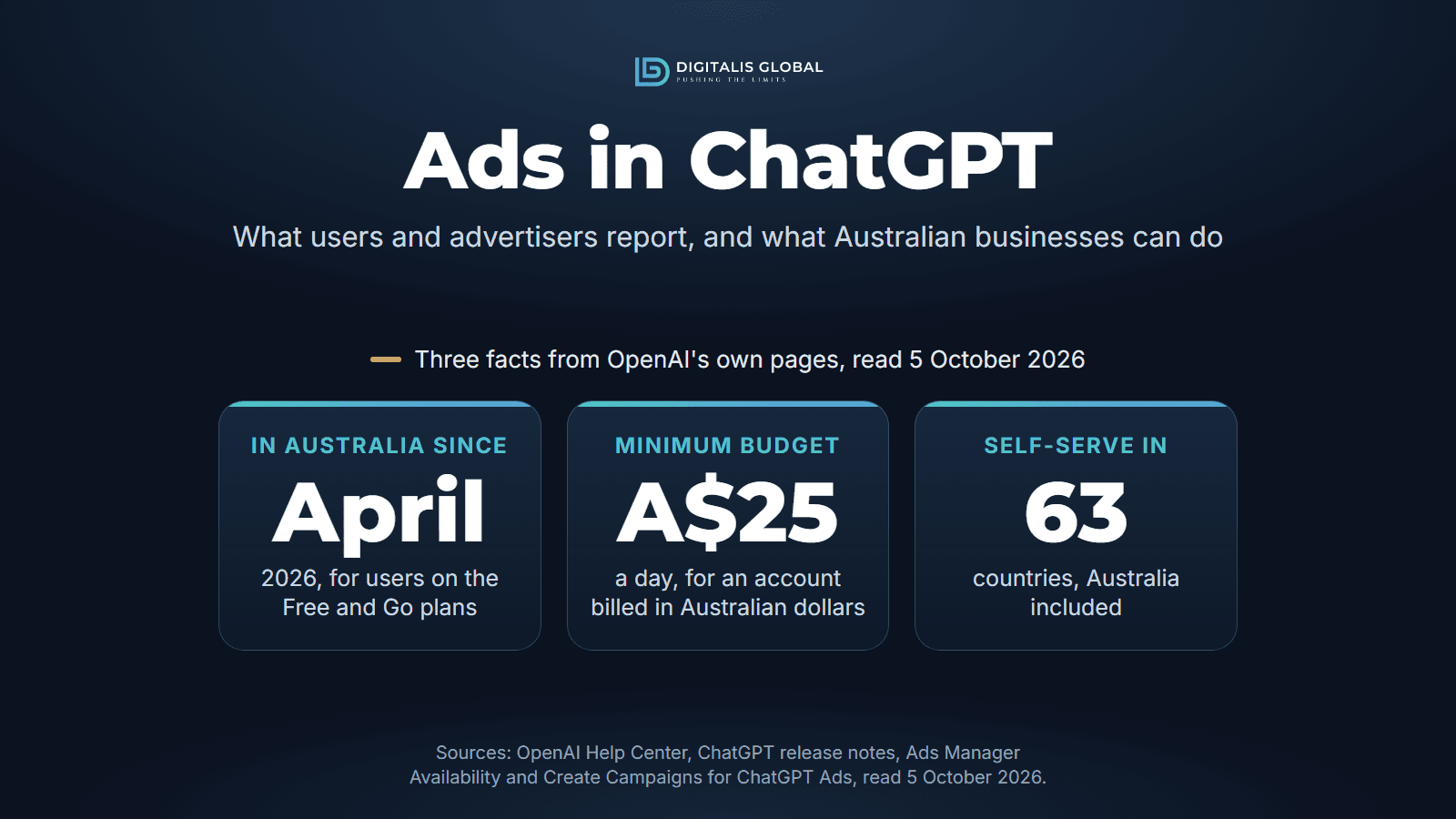
Yes, ChatGPT shows ads in Australia. OpenAI began rolling them out to Australian users on the Free and Go plans on 16 April 2026, below ChatGPT's answers and labelled as sponsored, and Australian businesses can now buy them in OpenAI's self-serve Ads Manager from A$25 a day, unless they sell financial, health or legal services, alcohol or gambling. The user reports we could read are mostly complaints: ads that crowd a phone screen, loose matches to the conversation, and Go subscribers surprised to see ads on a plan they pay for. Advertisers' public reports are few and mixed: small tests with click-through rates around 1% or lower, clicks that do not all show up in Google Analytics and few leads, alongside strong results in OpenAI's own case studies. This guide sets out OpenAI's rules as we read them on 5 October 2026, the reports we could check, how the mechanics compare with Google Ads and Meta Ads, and what an Australian business should do now.
What ChatGPT ads are and how they work
A ChatGPT ad is a small unit under ChatGPT's reply: the advertiser's name and logo, a headline, a description, an image and a link (OpenAI Help Center, Ads in ChatGPT: The Basics). One or more units can appear below a response, and online shops can run product feed ads built from an uploaded product feed (OpenAI Help Center, Ads in ChatGPT; OpenAI customer story: Newegg). All read 5 October 2026.
How an ad is chosen. There are no keywords to bid on in the Google Ads sense. OpenAI's system weighs the context and intent of the conversation, the ad's landing page and copy, the advertiser's targeting and "context hints" (descriptions of the conversations where a product is relevant) and, when ad personalisation is on, signals from your past chats and memory. OpenAI says context hints "are not exact-match keywords" and do not guarantee delivery. When several ads qualify, a relevance-weighted, second-price auction picks the winner. OpenAI also says ads run on separate systems from the chat model and that advertisers never receive your chats, memories, name, email address, precise location or IP address (OpenAI Help Center, Ads in ChatGPT: The Basics and Ads in ChatGPT). Those are OpenAI's own statements; we found no independent audit of them.
What advertisers set up. Campaigns are built in OpenAI Ads Manager, which OpenAI still labels a beta, and every ad is reviewed before it serves. You choose Views (pay per 1,000 impressions), Clicks (pay per valid click) or Conversions (optimised for a conversion but still billed per click or per 1,000 impressions). A daily budget is averaged across a Sunday to Saturday week, so one day can spend twice it and the week no more than seven times it, and the minimum is A$25 a day for an account billed in Australian dollars. You can target countries, states, cities and postcodes where available, though some new accounts can at first advertise only in their home country. A custom audience used for targeting needs at least 25,000 matched users (OpenAI Help Center, Create Campaigns for ChatGPT Ads, read 5 October 2026). OpenAI suggests starting cost-per-click bids at US$3 to US$5, which is a starting bid, not a measured average price (OpenAI Help Center, Ads in ChatGPT: The Basics).
How results are measured. Ads Manager reports impressions, clicks, spend, click-through rate, average costs and, once you install OpenAI's Pixel or Conversions API, conversions. Attribution is last-touch, with a 7, 14 or 30 day click window, and conversions can take 24 to 48 hours to appear. The same help page explains why ChatGPT ad clicks differ from Google Analytics sessions (OpenAI Help Center, Measure Results, read 5 October 2026).
Who sees ChatGPT ads, including in Australia
OpenAI started testing ads in the United States on 9 February 2026 and said on 26 March that pilots in Canada, Australia and New Zealand would follow "in the coming weeks" (OpenAI, Testing ads in ChatGPT). ChatGPT's release notes for 16 April 2026 say OpenAI was "beginning to roll out ads" to Free and Go users in all three countries (OpenAI Help Center, ChatGPT release notes), and Mi3 reported an OpenAI monetisation lead confirming the next day that the pilot was live (Mi3, 20 April 2026). A rollout that is beginning means not every Australian user saw ads from that day.
Buying opened in stages: OpenAI first sold directly to a small group of advertisers, then on 5 May 2026 added cost-per-click bidding and a beta self-serve Ads Manager (OpenAI, New ways to buy ChatGPT ads). On 23 September 2026 it said ads were sold in more than 60 countries, directly, through agencies including dentsu, Havas Media, Omnicom Media, Publicis Groupe and WPP, and through Ads Manager, and claimed US$1 billion in annualised revenue run rate within 200 days of launch, its own figure and not independently verified (OpenAI, ChatGPT Ads expands to Southeast Asia and Taiwan). Its availability list shows self-service open in 63 countries, Australia included, and the business that advertises and is billed must be based in one of them (OpenAI Help Center, Ads Manager Availability). All read 5 October 2026.
Ads may appear on the Free and Go plans only. OpenAI shows none to accounts it identifies as under 18 (using the stated age and an age prediction model), none near sensitive topics such as personal health, mental health or politics, none in Temporary Chats, and only all-audience ads to logged-out users. Free and Go users can turn off ad personalisation in Settings (they still see ads matched to the current chat), delete the ads data kept about them, and hide or report any ad. To remove ads altogether, pay for Plus or Pro, or switch the Free plan to its ads-free option, which has lower message limits and no image generation or deep research (OpenAI Help Center, Ads in ChatGPT, read 5 October 2026).
Which Australian businesses can advertise
Not every business can. OpenAI's ad policies, updated 10 September 2026, say the early categories are household and consumer goods, local services, travel and entertainment, and digital products and education. In the United States, financial and health services advertisers are approved case by case, and legal services only when the advertiser is licensed where the ad shows; outside the US, financial and health services ads are "generally prohibited" and legal services ads are prohibited. Alcohol, tobacco and vaping, gambling (beyond casino hotels and entertainment), dating and adult services, political content and individual job or property listings are not allowed (OpenAI, Ad policies, read 5 October 2026). So an Australian law firm, mortgage broker, financial adviser, medical clinic or bottle shop cannot run ChatGPT ads today, whatever its budget, and a real estate agency cannot advertise an individual listing.
What users report
We searched Reddit, Hacker News, the OpenAI Developer Community, Trustpilot, Whirlpool and trade press on 5 October 2026. Reddit, where much of this discussion happens, and Whirlpool both refused every tool we tried, so neither appears below. What remains is a small, self-selected sample: people who post about ads tend to dislike them. Each report is first-hand, one person's experience, and linked to the original.
| Where and when | What the user reported |
|---|---|
| Hacker News, 17 Feb 2026 | Dropped ChatGPT as soon as it became ad-supported and moved to Claude. |
| A marketer on X, quoted by Search Engine Roundtable, Feb 2026 | On mobile, an ad filled the screen when they started to reply, hiding the conversation. |
| Hacker News, 21 Apr 2026 | Asked about bleach; the ad at the bottom was for a different product from the one ChatGPT recommended in its answer. |
| OpenAI Developer Community, 23 Jun 2026 | A Go subscriber on Android found sponsored cards under responses cluttering the screen. |
| Hacker News, 25 Jun 2026 | A UK user paying £6.99 a month got ads for the Financial Times, Shein and Amazon Prime Day in a chat about mobile game tips, and cancelled. |
| Hacker News, 21 Jul 2026 | Gets ads that are "completely random": a chat about hardware brought an ad for a laptop, or for wood. |
| Hacker News, 21 Jul 2026 | Started paying for ChatGPT so as not to see ads. |
| Hacker News, 22 Jul 2026 | Tapping an ad in the mobile app opened the advertiser's site in a panel covering about 90% of the screen, with no option to open it in a browser. |
| Trustpilot, reviewer in Australia, 27 Aug 2026 | Moved down to the Go plan and objected to paying and still getting ads. |
| MediaPost columnist, 2 Sep 2026 | Sees small, clearly separated sponsored cards, finds them easy to ignore, and cannot remember what they advertised. |
Seen in several reports: ads taking too much of a phone screen; people surprised to see ads on a plan they pay for (in the UK, Australia and on Android), although OpenAI does list its paid Go plan as ad-supported; loose matches to the chat; and people leaving or paying to avoid ads. One-off: the ad that contradicted ChatGPT's own product recommendation. Not found: any first-hand report of an ad in a health, mental health or political conversation, or anyone describing the ads-free option or personalisation controls.
Wider data, with caveats. In a Forrester survey of 409 online adults in the US, UK and Canada (6 to 9 February 2026, not weighted), 83% said they would keep using free tiers despite ads and 6% would upgrade to a paid plan (Forrester, 10 February 2026). The monitoring firm Cloro found ads in 49.8% of the Australian ChatGPT responses it tracked in the week to 3 July 2026, but its prompts lean towards shopping and comparison questions, so that is not half of all Australian chats; a University of Pennsylvania and Haverford College audit found health, mental health and political prompts drew almost no ads (both reported by Mi3, 12 August 2026).
What advertisers and agencies report
The main finding is how little first-hand evidence exists. We found no public account with figures from an Australian business that bought ChatGPT ads. Most published tests come from agencies advertising their own services on budgets of a few hundred to a few thousand dollars, and some come from companies that sell ChatGPT advertising services, which we flag. Each is one advertiser's experience, not a measure of how ChatGPT ads perform. Figures are as each source published them; the US tests quote dollars, which we read as US dollars.
| Who and when | Spend | What they reported |
|---|---|---|
| Synter, US software company that supports ChatGPT ads (says so itself), 11 Jun 2026 | US$4,428.84 over 9 days, several countries | Australia cost US$17.59 a click at a 0.17% click-through rate, against US$10.62 in the US, on far lower Australian volume. |
| Virtual Marketers, New Zealand agency, own test, 8 Jul 2026 | NZ$164 over 9 days in June | 4,760 impressions, 30 clicks, 0.63% click-through rate, NZ$5.47 a click. Conversions not tracked. Setup took about 20 minutes. |
| Out of the Box Advisors, small business coach, 24 Jul 2026 (updated 20 Aug) | $500, then $175 | The first $500 went in about an hour: 140 clicks reported, about 13% reached the website, no leads. A slower second test had 68% of clicks reach the site. |
| Symphonic Digital, US agency, own services, 3 Aug 2026 | $50 a day for a month | 53 clicks in Ads Manager against 35 sessions in Google Analytics, about $9 a click, no completed leads. Running a second, bigger test. |
| Grow My Ads, US Google Ads agency, own services, 3 Aug 2026 | About $1,200 over two weeks | 92 clicks at $13 each, 1% click-through rate, no conversions. Not recommending it to clients yet. |
| Workshop Digital, US agency, own services, 26 Aug 2026 | $2,319 | 739 clicks, 1.1% click-through rate, $3.14 a click, no qualified leads. Will keep testing. |
| Windmill Strategy, US agency, own services, 2 Sep 2026 | $1,470 over 30 days | 259 clicks, 0.66% click-through rate, $5.68 a click (about a third of its usual Google search cost), no conversions. Will continue. |
| Common Thread Collective, US ecommerce agency, as reported by Search Engine Journal, 8 Sep 2026 | $9,620 | For a client selling high-priced products: $4.41 a click, 0.94% click-through rate, and a return on ad spend of 3.3 to 6.8 times, depending on the attribution model. |
Seen in several sources. Clicks in Ads Manager often exceed visits in the advertiser's own analytics: one agency told Digiday that ChatGPT reported "around 100 clicks where its own tracking picked up 20" (Digiday, 1 October 2026), another told MediaPost of 57 clicks against fewer than 20 visits (MediaPost, 28 August 2026), though two agencies told Digiday they saw no gap. Lead generation tests mostly produced no leads. Click-through rates sit around or below 1%: Graphite's analysis of Similarweb panel data put Australia at 0.67% and the US at 0.73% up to 16 September 2026 (Search Engine Journal, 29 September 2026). And reporting is thin, with no search terms, no auction insights and no OpenAI benchmarks (Search Engine Journal, 8 September 2026).
Invalid clicks. TrafficGuard, which sells click-fraud protection, says it analysed 40,000 ChatGPT ad clicks from 47 advertisers over three weeks and found invalid traffic as high as 34% for the worst-affected advertisers, while some campaigns were largely clean (Mi3, 2 October 2026). It is one vendor's own classification, but it is a reason to check clicks against your own data. OpenAI says it bills only valid clicks; how it filters them is not public.
In Australia. Mi3 named Alinta Energy, amaysim, Boost Mobile, Flip TV Australia, Luxury Escapes, Optus, the University of New England and The Iconic among early advertisers, detected by Cloro's monitoring rather than reported by the brands. Najib Raad, managing director of the agency Multimediax, told Mi3 that returns for his clients were positive but variable and below Google Ads, and that ChatGPT works best as a supplementary channel for people still researching, with attribution the hard part (Mi3, 12 August 2026). An advertiser on Hacker News put it more bluntly: after a month, performance was closer to social media than to Google search, and the paid traffic was "quite disengaged" (Hacker News, 22 July 2026).
The good results. The strongest results we found come from OpenAI's own customer stories, which OpenAI chooses and publishes: Newegg reports 3 times return on ad spend over 28 days, Jotform a cost per sign-up 30% lower than paid search, and Angi a 34% lower cost per lead since moving to conversion-optimised campaigns (OpenAI Ads, customer stories, read 5 October 2026). They show the channel can work for some large advertisers. They do not show how often it works.
How the price changed. Digiday reported US$60 per 1,000 impressions and a US$250,000 minimum commitment at launch, falling to US$25 to US$45 and US$50,000 by April (Digiday, 17 April 2026); the self-serve tool then dropped the minimum altogether (Digiday, 26 May 2026). Results from before May describe a different, pricier product.
How ChatGPT ads compare with Google Ads and Meta Ads
The table compares how each system works, not how well it performs. Performance depends on the business, the offer and the setup, and nobody has published a fair test of ChatGPT ads against the other two for Australian businesses that we could find.
| Mechanic | ChatGPT ads | Google Ads (Search) | Meta Ads |
|---|---|---|---|
| What triggers an ad | The context and intent of a conversation, guided by your context hints, which are not exact-match keywords | A search, matched against your keywords and their match types | An opportunity to show an ad to someone in a target audience you defined |
| Who wins the auction | A relevance-weighted, second-price auction on relevance and bid | Ad Rank: your bid, ad and landing page quality, Ad Rank thresholds, the search's context, expected impact of assets and competition | The highest "total value": your bid, estimated action rates and ad quality |
| How you pay | Per 1,000 impressions or per valid click; conversion-optimised campaigns are billed the same way | Per click on a cost-per-click campaign | A budget and a bid strategy you choose |
| Minimum spend | A$25 a day for an account billed in Australian dollars | None set: Google says bidding amounts are up to you | Not covered by the Meta page we read |
| Who you can reach | Adults on ChatGPT's Free and Go plans, in supported countries, outside sensitive conversations | People searching on Google, and sites that show Google ads | People on Facebook and other Meta technologies who fall in your audience |
| Maturity | Ads Manager is a beta; features, rules and availability changed several times in 2026 | Long established, with years of tools and documentation | Long established, with years of tools and documentation |
Sources: the OpenAI pages cited above, Google Ads Help, How the Google Ads auction works and Meta Business Help Centre, About ad auctions, all read 5 October 2026. Google's answer on minimum bids is from its bidding FAQ for Australia and New Zealand, last checked 28 September 2026 for our guide to Google Ads costs in Australia.
The practical difference is intent. A Google search states a need, with a keyword you can bid on exactly. A Meta ad reaches people who have not asked for anything. A ChatGPT ad sits in a conversation where someone is often comparing options, which is OpenAI's pitch, but you cannot choose the exact conversations, and the reporting is younger and thinner than either of the others.
What an Australian business should do now
ChatGPT ads are worth understanding now and worth testing only for some businesses. This is the order we would work through, using OpenAI's rules as read on 5 October 2026. Nothing here promises a result: the public evidence on returns is thin.
-

Step 1 · Before anything else
Check that your business is allowed to advertise
- Free
- Rules out finance, health, legal, alcohol, gambling and single property listings
Your business must be based in a listed country and sell in an allowed category: consumer goods, local services, travel and entertainment, or digital products and education (OpenAI, Ad policies). If you are excluded, check again in a few months; the policy has changed several times this year.
-

Step 2
Find out whether your customers ask ChatGPT about what you sell
- Free
- Tells you if a test is worth it
Ask new customers how they found you, and look in your analytics for visits referred from chatgpt.com. ChatGPT ads match conversations, so they suit things people research and compare: software, courses, travel, renovations, considered purchases. A business people find in an emergency, by typing "plumber near me" into Google, has less to gain.
-

Step 3 · Before you spend a dollar
Set up measurement you can check yourself
- Free to set up
- Click and session counts will not match exactly
Install OpenAI's Pixel (Google Tag Manager works) or Conversions API, tag every landing page URL, and set the campaign's conversion before traffic starts: OpenAI says events that do not match it show as zero and are not filled in later (OpenAI Help Center, Measure Results). Then compare Ads Manager's clicks with the sessions and enquiries in your own analytics.
-

Step 4
If you test, test small, with an end date
- From A$25 a day, OpenAI's minimum
- A day can spend twice the daily budget
Create the account with Australia, Australian dollars and your own time zone, because those settings cannot be changed later (OpenAI Help Center, Ads Manager Account Setup). Run one offer, choose the Clicks objective so you pay only for valid clicks, write context hints that describe the conversations where your product is the answer, and set a fixed budget and end date.
-

Step 5 · Alongside the rest
Keep the channels that already work, and judge on your own numbers
- No change to existing campaigns
- Judge on enquiries and sales, not clicks
Fund a test from a separate budget rather than by cutting Google Ads or Meta Ads that already produce enquiries. At the end, compare the cost per enquiry or sale in your own analytics with your other channels over the same period.
What ChatGPT ads cannot do
- Put you in ChatGPT's answer: OpenAI says ads run on separate systems and do not influence answers. Being recommended in the answer itself is a separate question of how your business appears across the web.
- Target exact searches: context hints guide matching but are not exact-match keywords and do not guarantee delivery.
- Charge you per lead: even conversion-optimised campaigns bill per click or per 1,000 impressions.
- Reach users on the higher plans: Plus, Pro, Business, Enterprise and Edu users never see ads.
We manage Google Ads and Meta Ads for Australian businesses through our performance marketing service, and our guide to Google Ads costs in Australia explains how that auction prices a click. If you are weighing a ChatGPT test against those channels, contact us and we will tell you what we would check first.
Common questions about ChatGPT ads
Are there ads in ChatGPT in Australia?
Yes. OpenAI began rolling out ads to Free and Go users in Australia, New Zealand and Canada on 16 April 2026, and Australian businesses can buy them through self-serve Ads Manager (OpenAI Help Center, ChatGPT release notes and Ads Manager Availability, read 5 October 2026).
How much do ChatGPT ads cost?
There is no fixed price: an auction sets it, you pay per 1,000 impressions or per valid click, the minimum daily budget for an account billed in Australian dollars is A$25, and OpenAI suggests starting cost-per-click bids at US$3 to US$5 (OpenAI Help Center, Create Campaigns for ChatGPT Ads and Ads in ChatGPT: The Basics, read 5 October 2026).
How do I turn off ads in ChatGPT?
Upgrade to Plus or Pro, or open Settings, Ads controls and choose the option to reduce message limits, which removes ads on the Free plan; turning off ad personalisation only changes which ads you see, not whether you see them (OpenAI Help Center, Ads in ChatGPT, read 5 October 2026).
Do ads change ChatGPT's answers?
OpenAI says no: ads run on separate systems from the chat model and advertisers cannot shape, rank or alter answers, though no independent audit of that has been published that we could find (OpenAI Help Center, Ads in ChatGPT, read 5 October 2026).
Can any Australian business advertise on ChatGPT?
No: the business must be based in a supported country and sell in an allowed category, and outside the US that excludes financial, health and legal services, as well as alcohol, gambling (beyond casino hotels and entertainment), dating, political ads and individual job or property listings (OpenAI, Ad policies, updated 10 September 2026, read 5 October 2026).
Sources
Every source below was read on 5 October 2026. OpenAI changes its help pages and policies often, sometimes daily, so check the linked page before you rely on a detail. Forum posts are individual reports, not evidence of how ChatGPT ads perform in general.
OpenAI
- OpenAI: Testing ads in ChatGPT (9 February 2026, with updates on 26 March, 7 May and 11 August 2026)
- OpenAI: New ways to buy ChatGPT ads (5 May 2026)
- OpenAI: ChatGPT Ads expands to Southeast Asia and Taiwan (23 September 2026)
- OpenAI: Ad policies (updated 10 September 2026)
- OpenAI Help Center: ChatGPT release notes (entry of 16 April 2026)
- OpenAI Help Center: Ads in ChatGPT
- OpenAI Help Center: Ads in ChatGPT: The Basics
- OpenAI Help Center: Ads Manager Availability
- OpenAI Help Center: Ads Manager Account Setup
- OpenAI Help Center: Quickstart: Launch your first campaign
- OpenAI Help Center: Create Campaigns for ChatGPT Ads (minimum daily budgets by currency)
- OpenAI Help Center: Measure Results
- OpenAI Ads and customer stories (published by OpenAI, 17 August to 22 September 2026)
Google and Meta
Press and research
- Mi3: ChatGPT ads pilot begins in Australia (20 April 2026)
- Mi3: Early ChatGPT ads surge in Australia (Andrew Birmingham, 12 August 2026)
- Mi3: TrafficGuard flags up to 34% invalid traffic across ChatGPT paid ads (2 October 2026)
- Digiday: ChatGPT ads are getting cheaper (Krystal Scanlon, 17 April 2026)
- Digiday: As OpenAI's ChatGPT ad delivery improves, the doubts it created aren't so easily fixed (26 May 2026)
- Digiday: OpenAI's measurement gaps are keeping ChatGPT ads budgets at test level (1 October 2026)
- MediaPost: Data Reveals ChatGPT Ads Not Performing (Laurie Sullivan, 28 August 2026)
- Search Engine Journal: 6 Months Into ChatGPT Ads, Advertisers Still Don't Know What 'Good' Looks Like (Brooke Osmundson, 8 September 2026)
- Search Engine Journal: ChatGPT ad click-through rates by market (Matt G. Southern, 29 September 2026)
- Forrester: What Consumers Actually Think About Ads In ChatGPT (Evelyn Mitchell-Wolf, 10 February 2026)
Advertiser write-ups and user reports: linked in the two tables above, with their dates.
Drafted with AI assistance; researched and reviewed by Saad Ali.
Founder / CEO